The average professional in this country wakes up in the morning, goes to work, comes home, eats dinner, and then goes to sleep, unaware that he or she has likely committed several federal crimes that day. Why? The answer lies in the very nature of modern federal criminal laws, which have exploded in number but also become impossibly broad and vague.
In Three Felonies a Day, Harvey A. Silverglate reveals how federal criminal laws have become dangerously disconnected from the English common law tradition and how prosecutors can pin arguable federal crimes on any one of us, for even the most seemingly innocuous behavior.
The volume of federal crimes in recent decades has increased well beyond the statute books and into the morass of the Code of Federal Regulations, handing federal prosecutors an additional trove of vague and exceedingly complex and technical prohibitions to stick on their hapless targets.
The dangers spelled out in Three Felonies a Day do not apply solely to “white collar criminals,” state and local politicians, and professionals. No social class or profession is safe from this troubling form of social control by the executive branch, and nothing less than the integrity of our constitutional democracy hangs in the balance.
ANSI’s 2025/2026 Student Paper Competition challenges high school & college students to investigate the invisible standards that keep our world running—from smartphone compatibility to food safety.
For nearly twenty years now, the American National Standards Institute Committee on Education administers a student paper competition intended to encourage understanding of the global standards system that also provides a solid prize — in the $1000 to $5000 range. The topic of the 2024 Student Paper Competition will be What Role Do or Could Standards Play in Safe and Effective Implementation of Artificial Intelligence Applications/Systems?
For the past six years Standards Michigan has hosted Saturday morning workshops to help students (and faculty) interested in entering the contest. We will soon post those dates on our CALENDER. We typically host them — three sessions ahead of the deadline — on Saturday mornings.
We provide links to previous paper winners and refer you to Lisa Rajchel: lrajchel@ansi.org for all other details.
Water is essential for sanitation and hygiene — and proper sanitation is essential for protecting water sources from contamination and ensuring access to safe drinking water. Access to safe water and sanitation is crucial for preventing the spread of waterborne diseases, which can be transmitted through contaminated water sources or poor sanitation practices. Lack of access to safe water and sanitation can lead to a range of health problems, including diarrheal diseases, cholera, typhoid, and hepatitis A.
On the other hand, poor sanitation practices, such as open defecation, can contaminate water sources, making them unsafe for drinking, bathing, or cooking. This contamination can lead to the spread of diseases and illness, particularly in developing countries where access to clean water and sanitation facilities may be limited.
We track the catalog of the following ANSI accredited standards developers that necessarily require mastery of building premise water systems:
American Society of Heating, Refrigerating and Air-Conditioning Engineers: ASHRAE develops standards related to heating, ventilation, air conditioning, refrigeration systems — and more recently, standards that claim jurisdiction over building sites.
American Society of Mechanical Engineers: ASME develops standards related to boilers, pressure vessels, and piping systems.
American Water Works Association: AWWA is a standards development organization that publishes a wide range of standards related to water supply, treatment, distribution, and storage.
ASTM International: ASTM develops and publishes voluntary consensus standards for various industries, including water-related standards. They cover topics such as water quality, water sampling, and water treatment.
National Fire Protection Association: NFPA develops fire safety standards, and some of their standards are related to water, such as those covering fire sprinkler systems and water supplies for firefighting within and outside buildings. We deal with the specific problems of sprinkler water system safety during our Prometheus colloquia.
National Sanitation Foundation International (NSF International): NSF International develops standards and conducts testing and certification for various products related to public health and safety, including standards for water treatment systems and products.
Underwriters Laboratories (UL): UL is a safety consulting and certification company that develops standards for various industries. They have standards related to water treatment systems, plumbing products, and fire protection systems.
* The evolution of building interior water systems has undergone significant changes over time to meet the evolving needs of society. Initially, water systems were rudimentary, primarily consisting of manually operated pumps and gravity-fed distribution systems. Water was manually fetched from wells or nearby sources, and indoor plumbing was virtually nonexistent.
The Industrial Revolution brought advancements in plumbing technology. The introduction of pressurized water systems and cast-iron pipes allowed for the centralized distribution of water within buildings. Separate pipes for hot and cold water became common, enabling more convenient access to water for various purposes. Additionally, the development of flush toilets and sewage systems improved sanitation and hygiene standards.
In the mid-20th century, the advent of plastic pipes, such as PVC (polyvinyl chloride) and CPVC (chlorinated polyvinyl chloride), revolutionized plumbing systems. These pipes offered durability, flexibility, and ease of installation, allowing for faster and more cost-effective construction.
The latter part of the 20th century witnessed a growing focus on water conservation and environmental sustainability. Low-flow fixtures, such as toilets, faucets, and showerheads, were introduced to reduce water consumption without compromising functionality. Greywater recycling systems emerged, allowing the reuse of water from sinks, showers, and laundry for non-potable purposes like irrigation.
With the advancement of digital technology, smart water systems have emerged in recent years. These systems integrate sensors, meters, and automated controls to monitor and manage water usage, detect leaks, and optimize water distribution within buildings. Smart technologies provide real-time data, enabling better water management, energy efficiency, and cost savings.
The future of building interior water systems is likely to focus on further improving efficiency, sustainability, and water quality. Innovations may include enhanced water purification techniques, decentralized water treatment systems, and increased integration of smart technologies to create more intelligent and sustainable water systems.
The first mover in building interior water supply systems can be traced back to the ancient civilizations of Mesopotamia, Egypt, and the Indus Valley. However, one of the earliest known examples of sophisticated indoor plumbing systems can be attributed to the ancient Romans.
The Romans were pioneers in constructing elaborate water supply and distribution networks within their cities. They developed aqueducts to transport water from distant sources to urban centers, allowing for a centralized water supply. The water was then distributed through a network of lead or clay pipes to public fountains, baths, and private residences.
One notable example of Roman plumbing ingenuity is the city of Pompeii, which was buried by the eruption of Mount Vesuvius in 79 AD. The excavation of Pompeii revealed a well-preserved plumbing system that included indoor plumbing in some houses. These systems featured piped water, private bathrooms with flushing toilets, and even hot and cold water systems.
The Romans also invented the concept of the cloaca maxima, an ancient sewer system that collected and transported wastewater away from the city to nearby bodies of water. This early recognition of the importance of sanitation and wastewater management was a significant advancement in public health.
While the Romans were not the only ancient civilization to develop indoor plumbing systems, their engineering prowess and widespread implementation of water supply and sanitation infrastructure make them a key player in the history of building interior water systems.
The first recorded public use of an elevator was in 1743, in a private residence in France. It was created by a French scientist and inventor named Louis-François Dauprat. However, this early elevator was not used for public transportation or in a commercial building.
The first practical passenger elevator was invented by Elisha Graves Otis, an American industrialist and inventor, in 1852. The Otis elevator used a safety device known as a “safety brake” or “safety hoist,” which prevented the elevator from falling in case the hoisting cable broke at a five-story building in New York City in 1857, known as Haughwout Building.
This invention revolutionized vertical transportation, allowing for the construction of taller buildings and changing the way people live and work in urban areas.
The earliest installation of a passenger elevator in a university building in the United States was at the Massachusetts Institute of Technology. In 1861, Otis Brothers & Co., the company founded by Elisha Graves Otis, installed the first passenger elevator on a university campus in the Rogers Building at MIT. The Rogers Building was a three-story structure that housed laboratories, classrooms, and offices for faculty and students. The installation of the passenger elevator provided vertical transportation within the building, making it more convenient for people to move between floors.
This early installation marked an important milestone in the history of vertical transportation on college and university campuses, and it paved the way for the adoption of elevators in other educational institutions as they expanded in size and height over time.
Here are some of the ways in which government regulations impede economic growth:
Increased costs: Regulations can impose additional costs on businesses, which can affect their ability to operate efficiently and compete in the marketplace. For example, regulations can require businesses to invest in new technologies or processes to comply with environmental or safety standards, which can increase their expenses.
Reduced innovation: Some people believe that regulations can stifle innovation and entrepreneurship, as businesses may be hesitant to invest in new products or technologies that could be subject to strict regulations. This can limit the potential for new businesses to emerge and grow.
Slowed job growth: Regulations can increase the cost of doing business, which can lead to reduced hiring and slower job growth. This can be particularly challenging for small businesses that may not have the resources to comply with regulatory requirements.
Reduced competition: Regulations can sometimes create barriers to entry for new businesses, which can reduce competition and limit economic growth. This can be particularly true in industries that are heavily regulated, such as healthcare and finance.
Reduced trade: Regulations can make it more difficult for businesses to operate in international markets, as they may face additional regulatory requirements and trade barriers. This can limit economic growth and reduce opportunities for businesses to expand their operations.
It is important to note that regulations can also have benefits, such as protecting consumers and the environment, promoting fair competition, and fostering innovation. It’s essential to strike a balance between regulatory requirements and economic growth to ensure that businesses can thrive while also protecting public health and safety.
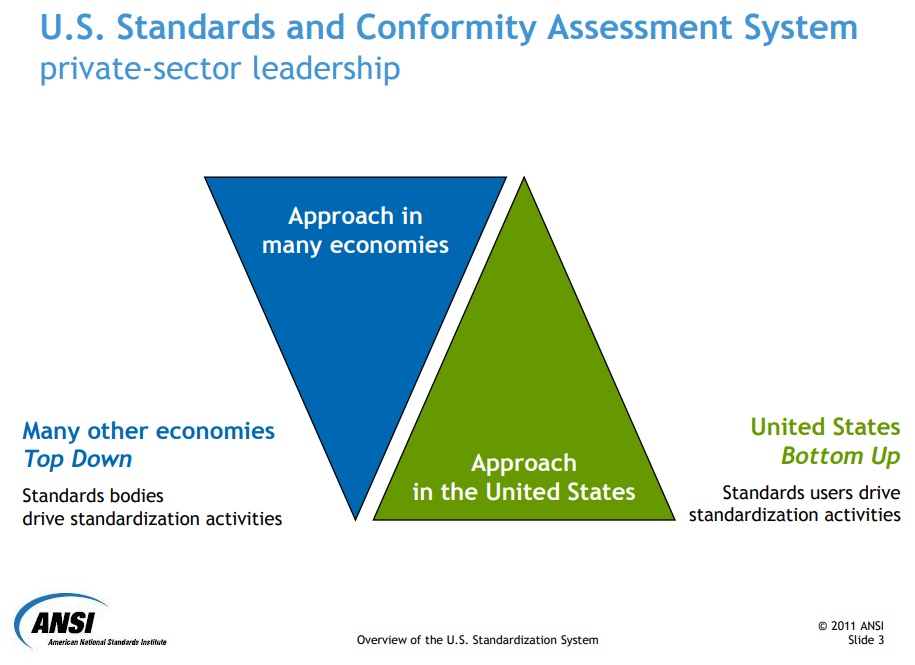
The U.S. Standards System effectively provides a “shadow government” that runs parallel to the elected government so that a balance of informed voices are present in formulating what Montesquieu called the “necessary laws”. See our ABOUT.
We find relatively few public consultations presented by accredited standards developers in the human resource domain; surprising because human resources are the largest cost center in nearly every industry. Alas, manufacturers, insurance and conformance companies remain the strongest voices; the “wicked problem” we describe in our ABOUT.
Even before the circumstances of the pandemic inspired a revisit of large government politics and cultural mashing in education communities in the United States we could hear the first footfalls of disruption when ANSI catalyzed the creation of a related entity in 2014, described in the link below:
The proper business of the education industry overall — and the ~$500 billion facility segment we track — is preparing the workforce everywhere to contribute to national economic priorities. There is a strong cultural component in the human resource domain — i.e. branding — the topic of another post. For now, we simply suggest that much of the economic activity of education communities is devoted to building a cohort (or guild) that creates an emotional bond that hastens learning and a continual desire to self-educate to remain part of the cohort.
At the moment, the WORKCRED program at this point in its development, appears to provides guidance to conformance and compliance organizations among its members. The user-interest in the education facility industry, at least dependent on a skilled workforce as any economic sector, and welcomed to participate. We identify the initiative here and will keep a weather-eye out for commenting opportunities on draft consensus products emerging from it. The link below should provide a more detailed overview of the program until a “commentable consensus product” suitable for incorporation by reference into legislation is released.
Of course, there will be cultural competition among the guardians of the cohort.
Organizations with their own credentialing enterprises for skilled trades, ICT, software engineering, etc. — are encouraged to communicate directly with the WORKCRED staff (CLICK HERE).
With many non-profit organizations also challenged by the pandemic we are likely to see fewer experts at technology, finance and management gatherings where leading practice is discovered and promulgated. That does not mean that many gatherings will not be offloaded onto the internet but, with fewer paid experts involved, one wonders whether there will be fewer unpaid experts — or will there be more unpaid experts? We shall see.
Since the United States federal government can print money it is likely that more decision-making will be drawn back to Washington D.C. — where the money is. The likelihood that we shall see greater federal control over education facility industry originating at the federal level inspires a revisit of the United States standards system. The National Institute of Standards and Technology is the oversight agency and the American National Standards Institute is the private non-profit organization that oversees the development of voluntary consensus standards for products, services, processes, systems, and personnel in the United States.
Bringing technology and industrial innovation to market more quickly
Encouraging cooperative research and development between business and the federal government by providing access to federal laboratories
Making it easier for businesses to obtain exclusive licenses to technology and inventions that result from cooperative research with the federal government
The NTTAA — along with administrative circular A-119 from the White House Office of Management and Budget — made a direct impact on the development of new industrial and technology standards by requiring that all Federal agencies use privately developed standards, particularly those developed by standards developing organizations accredited by the American National Standards Institute (ANSI). In circular A-119 federal agencies were also encouraged to participate in the development of those standards. While discussion continues about how well the US non-government sector is doing to advance national technology strategy continues (see January 17, 2012 White House Memo M-12-08) the US standards system remains the most effective process for advancing national technology and economic priorities for the education university and others.
Comments are due by March 26th. You may comment directly to ANSI at this email address: psa@ansi.org. With respect to our higher priorities, we will not be commenting on this redline, though intellectual property and patent policies are high on the agenda of many research universities. We have advocated in other parts of the ANSI Essential Requirements document in the past, however — a history we are happy to explain at any of our weekly Open Door teleconferences every Wednesday, 11 AM Eastern time. Anyone is welcomed to join these discussions with the login information in the link below:
New update alert! The 2022 update to the Trademark Assignment Dataset is now available online. Find 1.29 million trademark assignments, involving 2.28 million unique trademark properties issued by the USPTO between March 1952 and January 2023: https://t.co/njrDAbSpwBpic.twitter.com/GkAXrHoQ9T