Category Archives: Student Paper

Loading
loading...

2025-2026 Student Paper Competition

ANSI Rebrands Flagship Conference: ANSI Innovation Summit Replaces World Standards Week

“Boy Writing with Sister” 1875 Albert Anker


ANSI Student Paper Competition paused for 2025

No award for the 2024 cycle (per COE Chairperson)

“A Girl Writing; The Pet Goldfinch” 1870 Henriette Browne


The Society for Standardization Professionals Paper Competition 2025


Updated January 7, 2024


For nearly twenty years now,  the American National Standards Institute Committee on Education administers a student paper competition intended to encourage understanding of the global standards system that also provides a solid prize — in the $1000 to $5000 range.  The topic of the 2024 Student Paper Competition will be What Role Do or Could Standards Play in Safe and Effective Implementation of Artificial Intelligence Applications/Systems?

Student Paper Competition Flyer 2024 – Entries due 7 June 2024

For the past six years Standards Michigan has hosted Saturday morning workshops to help students (and faculty) interested in entering the contest.   We will soon post those dates on our CALENDER.  We typically host them — three sessions ahead of the deadline — on Saturday mornings.

We provide links to previous paper winners and refer you to Lisa Rajchel: lrajchel@ansi.org for all other details.

Related:


“Normal” Things Americans Do That The Rest Of The World Will Never Understand

ANSI Accredited Standards Developers | Contact Information

2023 Student Paper Competition

2022 Student Paper Competition

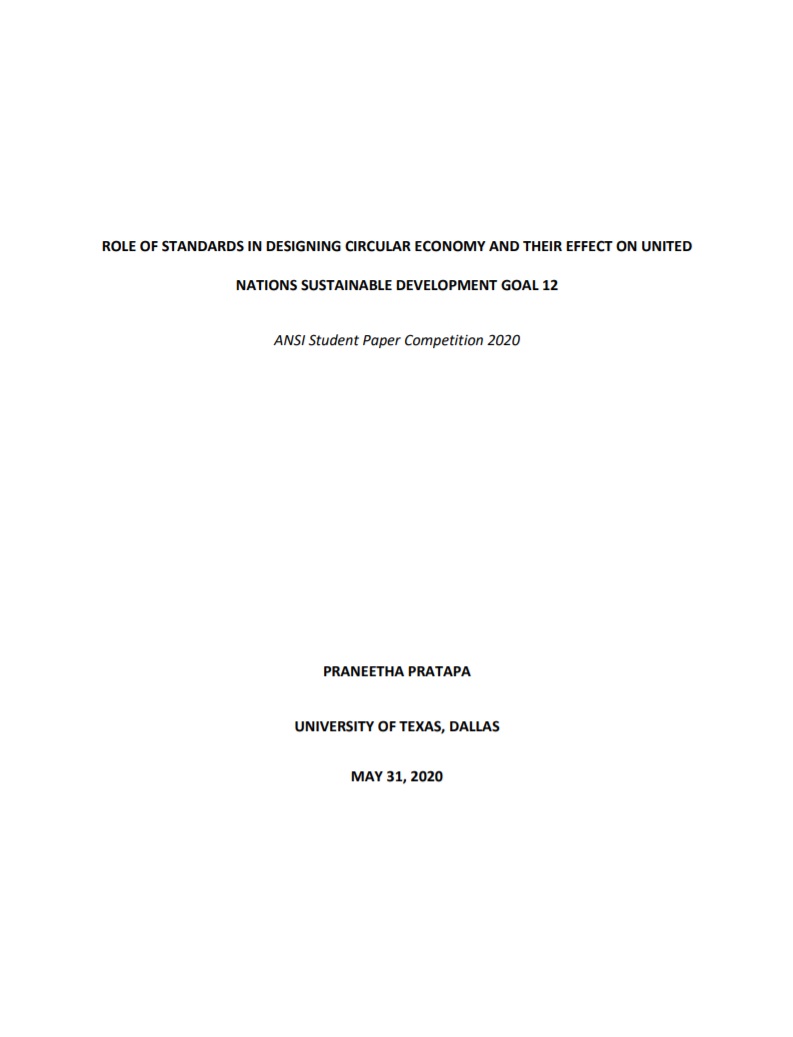
2020 Student Paper Winner / Remanufacturing

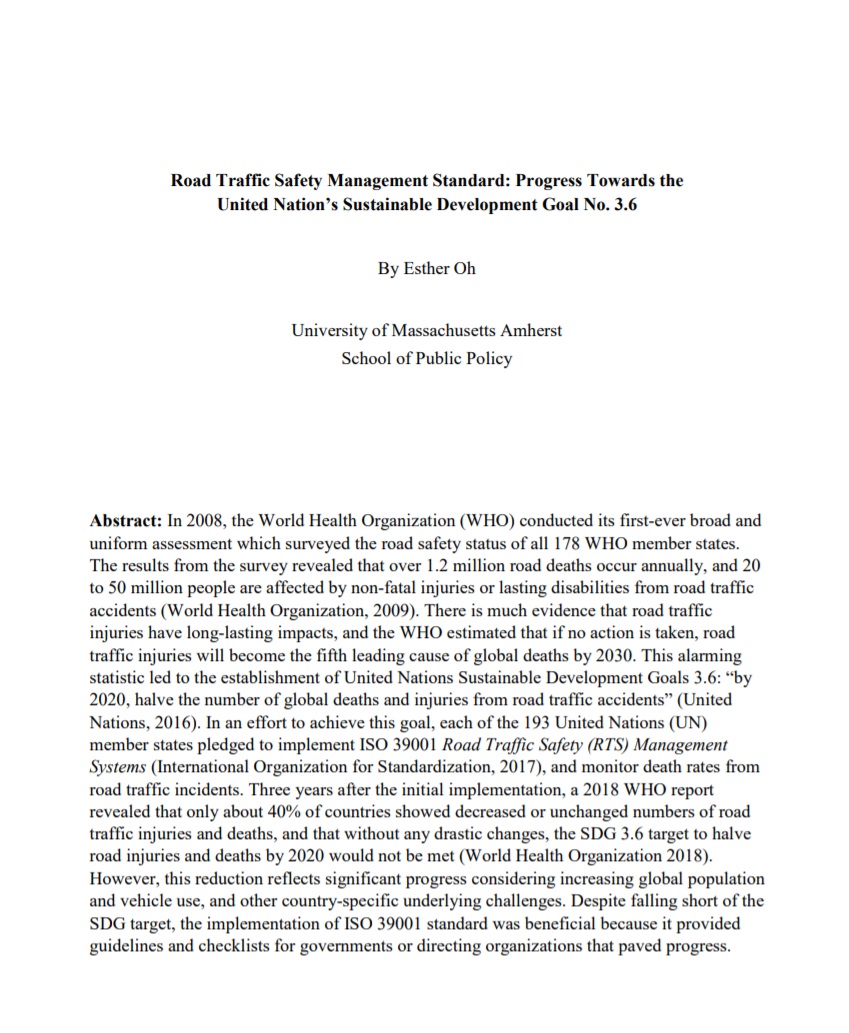
2020 Student Paper Winner / Road Traffic Safety

ANSI 2019 Student Paper Winner: Cybersecurity & Ukraine Power Grid Attack

2019 Student Paper Winner / Standards in Crisis Prevention & Response:

2018 ANSI Student Paper Winner / Internet of Things

2017 ANSI Student Paper Winner / Cyborg Gen 2330

2016 Student Paper Winner | Life, Liberty and Pursuit of Happiness

2016 Student Paper Winner / World Without Standards

United States Standards Strategy

2022 Student Paper Competition

Every year, ANSI’s Committee on Education administers a student paper competition intended to encourage understanding of the global standards system that also provides a solid prize — in the $1000 to $5000 range.  The topic of the 2022 Student Paper Competition will be: “Standards Support Innovation, Cooperation and Excellence at the Olympic Games”

ANSI 2022 Student Paper Competition Flyer

 The deadline is June 1, 2022 11 PM ET.

For the past four years Standards Michigan has hosted four Saturday workshops to help students (and faculty) interested in entering the contest.  We will do so again this year. (See our 2022 April – May CALENDAR).   Other universities offer credited courses that include leading practice discovery processes and promulgation (CLICK HERE for directory)

We provide links to previous paper winners and refer you to Lisa Rajchel: lrajchel@ansi.org for all other details.

The 2021 Student Paper Winners will be announced at ANSI’s World Standards Week (October 25-30)

2020 Student Paper Winner / Remanufacturing

2020 Student Paper Winner / Road Traffic Safety

ANSI 2019 Student Paper Winner: Cybersecurity & Ukraine Power Grid Attack

2019 Student Paper Winner / Standards in Crisis Prevention & Response:

2018 ANSI Student Paper Winner / Internet of Things

2017 ANSI Student Paper Winner / Cyborg Gen 2330

2016 Student Paper Winner | Life, Liberty and Pursuit of Happiness

2016 Student Paper Winner / World Without Standards


ANSI 2019 Student Paper Winner: Cybersecurity & Ukraine Power Grid Attack

Missouri State University

Cybersecurity Standards and the 2015 Ukraine Power Grid Attack: Mitigating Catastrophic Cyber Disruptions on Electrical Infrastructure

By Sam Cohen
Missouri State University DC Graduate Campus
Georgetown University

Abstract: The 2015 attack on Ukraine’s power grid represented the first publically documented cyber incident disrupting electrical utility and power distribution control systems. While the incident was temporary, it impacted critical services supporting 225,000 customers—including businesses, industrial facilities, and government offices. The attack has been recognized as a highly complex and persistent operation that could have escalated to a significantly larger power outage disaster, threatening long-term essential service disruptions at hospitals, government facilities, telecommunication sites, and financial institutions. This paper examines how cybersecurity standards developed or approved by organizations such as the National Institute for Standards and Technology (NIST), the American National Standards Institute (ANSI), the International Organization for Standardization (ISO), the North American Electric Reliability Corporation (NERC), and the International Electrotechnical Commission (IEC) could have either mitigated or entirely prevented this attack. Specifically, log collection and analysis (NERC CIP007-6 and NIST SP-800-92), external network and boundary protection (IEC 62443-3, adopted as ANSI/ISA 99.03.03), and incident response (NIST-7628 Rev.1 and ISO/IEC 27002:2013) standards are mapped against key cybersecurity gaps that enabled the attackers to compromise and exploit key assets throughout Ukraine. The paper then determines how controls listed in these standards could have assisted cybersecurity and IT staff with the defense of their control systems and supervisory control and data acquisition (SCADA) networks, thereby reducing the destructive potential of the attack and possibly mitigating the disaster altogether. The standards analyzed in this paper are identified for their mitigation utility during the Ukraine attacks, and also for their applicability to any power grid owner or operator aiming to reduce cyber risk.

Issue: [12-78]

Category: Academics, Public Policy

Colleagues: Mike Anthony, Christine Fischer, Paul Green, 


More

2022 Student Paper Competition

ANSI Essential Requirements: Due process requirements for American National Standards. 

ANSI Committee on Education Student Paper Competition

https://www.standardslearn.org/

Missouri State University Department of Defense and Strategic Studies


2019 Student Paper Winner / Standards in Crisis Prevention & Response:

Rowan University / Glassboro, New Jersey

Standards in Crisis Prevention and Response: Inconspicuous but at the Core

By Scott Brody

Rowan University in New Jersey

Abstract.   Standards play a central role in emergency management by providing thoroughly tested and increasingly globally applicable solutions to a host of challenges in both the crisis prevention and response domains. Recognizing that safety is universal, standards development organizations (SDOs) create deliverables for many audiences. Some documents, such as life safety codes, are meant to be followed by manufacturers, service providers, and other businesses and groups that serve the public. Other times, standards-based tools are geared towards expert analysts. Nearly all first responders rely upon standards to help control incidents ranging from everyday service calls to catastrophes.  Procedures covered by standards include but are not limited to response, investigation, training, equipment, and information technology. To prevent repeats of past system failures, SDOs play a key role in public policy formation. They strive to advance effective policies that often rely upon the implementation of voluntary consensus standards incorporated by reference into rulemaking. This can be seen with the post-9/11 efforts to standardize ID and passport security. Though content is unique, the role of standards in crisis prevention and response is not fundamentally different from other fields. SDOs rely on the expertise of diverse stakeholders from industry, government, and consumer groups who come to consensus on best practices. This expert-based, time-tested nature makes the methods outlined in standards the simple and lower-risk choice for countless emergency-related decisions.

Issue: [12-78]

Category: Academics, Public Policy

Colleagues: Mike Anthony, Christine Fischer, Paul Green


LEARN MORE:

ANSI Essential Requirements: Due process requirements for American National Standards. 

ANSI Committee on Education Student Paper Competition

https://www.standardslearn.org/

2018 ANSI Student Paper Winner / Internet of Things


Originally posted October 22, 2018


The ANSI Committee on Education met last week in Washington D.C. during World Standards Week and posted an update on its activity:

ANSI WSW 2018 CoE Update October 2018

One of the highlights of the CoE’s work is determination of the student paper winner, this year given to Julia Suozzi of the University of Virginia for her paper, linked below:

When Mundane Objects Become Smart: Challenges of Standardizing the Internet of Things

Abstract.  The purpose of this essay is to address the need for standards in modern communication, explain the challenges in creating these standards, and propose various solutions to these challenges. With the evolution of the Internet of Things (IoT), everyday objects have transformed into connected devices that are vulnerable to a host of attacks. In order to protect users, standards must be put into place. Although necessary, standards are extremely complex to develop due to their sociotechnical nature. Challenges in this process include market definition, determining what and when to standardize, organizational responsibility, and international competition. First, market definition must be considered due to the nature of standards compliance. Businesses comply with standards when there is a market associated with them and that market is well-defined. Since the IoT does not have such a monolithic market, how should standards be created? The next major challenge is knowing what to standardize and when it is appropriate to do so. This paper will explore approaches as described by members of the government, industry, and academia. 

Responsibility is also a major challenge of standardizing the IoT. With so many organizations holding stake in the process, who is truly responsible for taking the lead? This question brings up issues of organizational politics, as each group has their own agenda and mechanism for reaching consensus. Lastly is a discussion of international competition. Many organizations involved in IoT standardization have international participation. Each of these nations has a fundamentally different view on issues such as “safety,” “privacy,” and “security,” making it difficult to reach global consensus. This issue is explored using the recent US-China trade war. In order to better understand these challenges and discuss potential discourse, a case study based on interviews with key IoT stakeholders is presented, focusing on the Internet Engineering Task Force, the Institute of Electrical and Electronics Engineers, and the National Institute of Standards and Technology

One of the best ways to teach standards is to do standards.  Standards Michigan now has a footprint in all fifty United States and, as the first mover and catalyst for user-interest standards advocacy by the education facilities industry (see ABOUT), we are happy to walk anyone through the regulatory landscape where the technical and business specifics of planning, designing, building, operating, maintaining and managing these “cities-within-cities” that we call the emergent #SmartCampus.

Information about how to get started on entering the 2019 competition is available in the link below:

ANSI Announces 2019 Student Paper Competition: “How Do Standards Help Mitigate Disaster?”

We welcome faculty, students and subject matter experts to our livecasts (11 AM Eastern time every day) to participate in “code-writing and vote getting” — i.e the essential substance of our approach to lowering the #TotalCostofOwnership of education in the United States and elsewhere.  We do less standards administration and conformity and more “getting into the weeds” of leading practice discovery and promulgation.  Getting into the weeds is the most effective way to understand and master the methods of becoming effective in standards advocacy; especially in the standards suites that are incorporated by reference into public safety and sustainability legislation.

Issue: [12-78]

Category: Academics, Public Policy

Colleagues: Mike Anthony, Christine Fischer, Paul Green,  Julia Suozzi


LEARN MORE:

ANSI Essential Requirements: Due process requirements for American National Standards.  (In effect, this is the equivalent of the US Constitution in the private standards development)

https://www.standardslearn.org/


2016 Student Paper Winner / World Without Standards

ANSI’s Committee on Education develops long-term strategies and action steps for the academic side of the education industry to promote the integration of standards and conformity assessment in the curricula in order to educate the next generation of business leaders on the strategic impact of standards and conformity assessment.

ANSI Announces Winners of 2016 Student Paper Competition

The Bleak Reality of a World without Standards
Amanda Goetz, Branden Hill, Libby Lee, & Jennifer Pattillo | Ferris State University | April 20, 2016


CLICK HERE FOR ALL 2016 STUDENT PAPER WINNERS 

2020 Student Paper Competition


“Education is not the filling of a pail,

but the lighting of a fire.”

— William Butler Yeats


The United Nations Sustainable Development Goals serve as a call to action for all countries of the world to promote health, safety, and prosperity while protecting the planet.  They recognize that ending poverty must go hand-in-hand with strategies that build economic growth and address a range of social needs, and they call upon the creativity, know-how, technology, and resources from all of society to achieve them.

This is list of 17 goals to transform our world:

GOAL 1: No Poverty

GOAL 2: Zero Hunger

GOAL 3: Good Health and Well-being

GOAL 4: Quality Education

GOAL 5: Gender Equality

GOAL 6: Clean Water and Sanitation

GOAL 7: Affordable and Clean Energy

GOAL 8: Decent Work and Economic Growth

GOAL 9: Industry, Innovation and Infrastructure

GOAL 10: Reduced Inequality

GOAL 11: Sustainable Cities and Communities

GOAL 12: Responsible Consumption and Production

GOAL 13: Climate Action

GOAL 14: Life Below Water

GOAL 15: Life on Land

GOAL 16: Peace and Justice Strong Institutions

GOAL 17: Partnerships to achieve the Goal

To highlight the power of standards as a tool in these efforts, the American National Standards Institute (ANSI) 2020 Student Paper Competition asks you to choose one of the 17 UN Sustainable Development Goals and explore the ways in which standards play a role in achieving it, or could in the future. Your paper should identify a relevant standard or multiple standards and discuss how they can contribute to strategies and solutions for reaching the targets set out in one of the Sustainable Development Goals.

Here are the guidelines:

Be written and submitted by student(s) (associate, undergraduate, or graduate, in any discipline) enrolled full- or part-time during the period of September 2019 to April 2020 at an institute of higher education located in the United States or its territories

Include a title and a list of names of all contributing authors, their contact details, and the affiliated institute of higher education

Be prefaced with an abstract of no more than 400 words

Be less than 2,000 words (not including requirements #2 and #3 above, notes, tables, charts, and a bibliography which may not exceed 3 pages)

Be in English and suitable for publication (nal editing assistance will be provided before publication of winning papers)

Be submitted in electronic format, preferably Microsoft Word or other revisable format, in 12-point type size

Be original and not previously published (copyright will remain with the author; winners grant publication rights to ANSI, as well as the right to release entries to other media)

More detail is available in the link below:

ANSI Student Paper Competition 2020 – Papers Due 31 May 2020*

Standards Michigan will host four 11 AM/ET Saturday workshop in 2020 for anyone interested in guidance within the limits of our expertise.  (See our ABOUT).

January 18

February 15

March 14

April 18

May 23

May 30

Students and faculty sponsoring students are welcomed to click in.   Standards Michigan is a member of the ANSI Committee on Education and collaborates closely with two University of Michigan faculty familiar with the competition.  See our CALENDAR for login credentials.

*On March 23rd, the ANSI Committee on Education moved the deadline back a month, owing to global pandemic circumstances.


LEARN MORE:

ANSI COMMITTEE ON EDUCATION OPERATING GUIDELINES

2025-2026 Student Paper Competition


Layout mode
Predefined Skins
Custom Colors
Choose your skin color
Patterns Background
Images Background
Standards Michigan
error: Content is protected !!
Skip to content