
Category Archives: Monthly Food

Loading
loading...

Food Safety

Overdoor, France, ca. 1825; | Smithsonian Design Museum

Education communities have significant food safety responsibilities.  Risk gets pushed around global food service counterparties; a drama in itself and one that requires coverage in a separate blog post.*

Since 2013 we have been following the development of food safety standards; among them ANSI/NSF 2: Food Equipment one of a constellation of NSF food safety titles whose provisions cover bakery, cafeteria, kitchen, and pantry units and other food handling and processing equipment such as tables and components, counters, hoods, shelves, and sinks.  The purpose of this Standard is to establish minimum food protection and sanitation requirements for the materials, design, fabrication, construction, and performance of food handling and processing equipment.

It is a relatively stable standard; developed to support conformance revenue for products.  A new landing page seems to have emerged in recent months:

Food and Beverage

https://www.nsf.org/testing/food


You may be enlightened by the concepts running through this standard as can be seen on a past, pre-pandemic agenda:

NSF 2 Food Safety 2019 Meeting Packet – Final Draft

NSF 2 Food Safety 2019 Meeting Summary – August 21-22 Ann Arbor NSF Headquarters

NSF 2 Food Equipment Fabrication Agenda – FEF – TG – 2021-01-12

Not trivial agendas with concepts that cut across several disciplines involving product manufacture, installation, operation and maintenance.  We find a very strong influence of organizations such as Aramark and Sodexo.   More on that in a separate post.

Ranchview High School Cafeteria / Irving, Texas

This committee – along with several other joint committees –meets frequently online.  If you wish to participate, and receive access to documents that explain the scope and scale of NSF food safety standards, please contact Allan Rose, (734) 827-3817, arose@nsf.org.   NSF International welcomes guests/observers to nearly all of its standards-setting technical committees.   We expect another online meeting hosted by this committee any day now.

Keep in mind that all NSF International titles are on the standing agenda of our Nourriture (Food) colloquia; open to everyone.  See our CALENDAR for the next meeting.
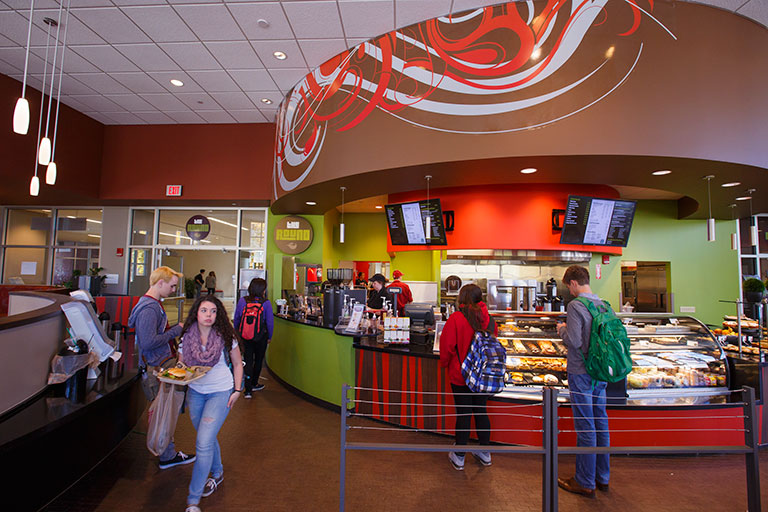
University of Indiana

Issue: [13-113] [15-126]

Category: Facility Asset Management, Healthcare, Residence Hall, Athletics

Colleagues: Mike Anthony, Tracey Artley, Keith Koster, Richard Robben

*See “Food Safety Risk Management: Evidence-Informed Policies and Decisions, Considering Multiple Factors, Food and Agriculture Organization of the United Nations”


LEARN MORE:

ANSI Blog | Changes to NSF 2 Food Safety Equipment Standard

NSF International Food Safety 2018 Meeting Summary – 2018-08-22 – Final Draft

2017 Food Code | US Food & Drug Administration

Hygiene Requirements For The Design Of Meat And Poultry Processing Equipment
ARCHIVE: NSF 2 Food Safety

Food Code 2022

“Fall Plowing” | Gant Wood (1880)

Food safety is an obvious priority for education communities, given the prevalence of school lunch programs, student residence meal services, university-affiliated hospitals, athletic and entertainment event concessions — too many to count.   We find food services in the interstitial spaces of traditional educational occupancies such as libraries and student recreation centers.  Many land grant colleges and universities were founded to develop agricultural programs for local food supply and safety.  It is fair to say that there are far more people involved in food preparation and delivery services than there are skilled tradespersons such as electricians, plumbers, carpenters, software programmers, etc.

The food supply chain is an essential feature of education community infrastructure so we track the literature of food safety and sustainability here; starting with one of its foundational documents with the force of law.

FOOD CODE 2022

Morrill Land-Grant Act

IEEE Rural Electric Power Conference |  Agricultural Extension Offices

“Harvest Rest”  1865 George Cole

“Agriculture is our wisest pursuit, because it will in the end

contribute most to real wealth, good morals, and happiness.”

— Thomas Jefferson

From the Wikipedia: Land-grant university

“…A land-grant university (also called land-grant college or land-grant institution) is an institution of higher education in the United States designated by a state to receive the benefits of the Morrill Acts of 1862 and 1890.

The Morrill Acts funded educational institutions by granting federally controlled land to the states for them to sell, to raise funds, to establish and endow “land-grant” colleges. The mission of these institutions as set forth in the 1862 Act is to focus on the teaching of practical agriculture, science, military science, and engineering (though “without excluding… classical studies”), as a response to the industrial revolution and changing social class.  This mission was in contrast to the historic practice of higher education to focus on a liberal arts curriculum. A 1994 expansion gave land grant status to several tribal colleges and universities….”

Link to the original legislation:

THIRTY-SEVENTH CONGRESS / Approved July 2, 1862

The Morrill Land-Grant Act has not undergone significant changes in its core structure within the past decade. However, there have been important developments and discussions surrounding its implementation, particularly regarding the use of land originally designated under the Act.

One key area of focus has been the ongoing management of trust lands associated with land-grant universities. Investigations have revealed that many of these lands continue to generate substantial revenue, often through activities such as fossil fuel production, mining, timber sales, and agriculture.

For instance, between 2018 and 2022, trust lands associated with land-grant universities generated over $6.7 billion in revenue. These investigations have also highlighted the historical context of how these lands were acquired, often from Indigenous nations, sparking ongoing debates about equity and restitution.

Several universities associated with the Morrill Land-Grant Act continue to generate significant revenue from fossil fuels, timber, and agricultural activities. Here are some examples:

  1. Washington State University (WSU): WSU benefits from timber sales on its trust lands, which have generated over $1.1 billion in revenue from 1889 to 2022. These lands are used for timber production, grazing, and other activities​ (Grist).
  2. University of Arizona: The university’s trust lands are involved in grazing, timber, and fossil fuel production. These lands generate revenue through leases for activities such as mining and oil extraction​ (Grist).
  3. University of Texas: The Permanent University Fund, which includes land-grant lands, generates revenue primarily through oil and gas production. The University of Texas system benefits significantly from these fossil fuel activities​ (Grist).
  4. University of Wyoming: Like other land-grant institutions, the University of Wyoming manages trust lands that produce revenue through activities like coal mining and grazing​ (Grist).

These activities raise important questions about the environmental and ethical implications of continuing to use land-grant trust lands in this manner, especially given the historical context of how these lands were acquired.


Point / Counterpoint


Climate Psychosis

Blockchain Tokens for Food Traceability

Integrating Blockchain, Smart Contract-Tokens, and IoT to Design a Food Traceability Solution

Mark Kim – Brian Hilton
Info. Systems and Technology, Claremont Graduate University
Zach Burks – Jordan Reyes
Harvest Network, Bakersfield, CA, USA


Abstract:  Information asymmetry exists amongst stakeholders in the current food supply chain. Lack of standardization in data format, lack of regulations, and siloed, legacy information systems exasperate the problem. Global agriculture trade is increasing creating a greater need for traceability in the global supply chain. This paper introduces Harvest Network, a theoretical end-to-end, vis a vie “farm-to-fork”, food traceability application integrating the Ethereum blockchain and IoT devices exchanging GS1 message standards. The goal is to create a distributed ledger accessible for all stakeholders in the supply chain. Our design effort creates a basic framework (artefact) for building a prototype or simulation using existing technologies and protocols [1]. The next step is for industry practitioners and researchers to apply AGILE methods for creating working prototypes and advanced projects that bring about greater transparency.

Document Sections
    • I. Introduction
    • II.  New Paradigm for Food Traceability
    • III. Tokenization Overview
    • IV. Smart Contract Design and IoT Interaction
    • V. Web Integration


PURCHASE INFORMATION: IEEE Digital Library


Coffee

“The morning cup of coffee has an exhilaration about it which the cheering influence
of the afternoon or evening cup of tea cannot be expected to reproduce.”
– Oliver Wendell Holmes Sr. (The Autocrat of the Breakfast Table, 1858)

Norges Teknisk-Naturvitenskapelige Universitet

As the U.S. member body to the International Organization for Standardization (ISO), the American National Standards Institute (ANSI) encourages its members and relevant stakeholders to participate in discovering standardization solutions in a broad range of technologies and markets with like-minded experts in other national standards bodies.  The full sweep of ANSI’s participation in consensus documents developed by the ISO is described in the link below:

ISO Programs – Overview

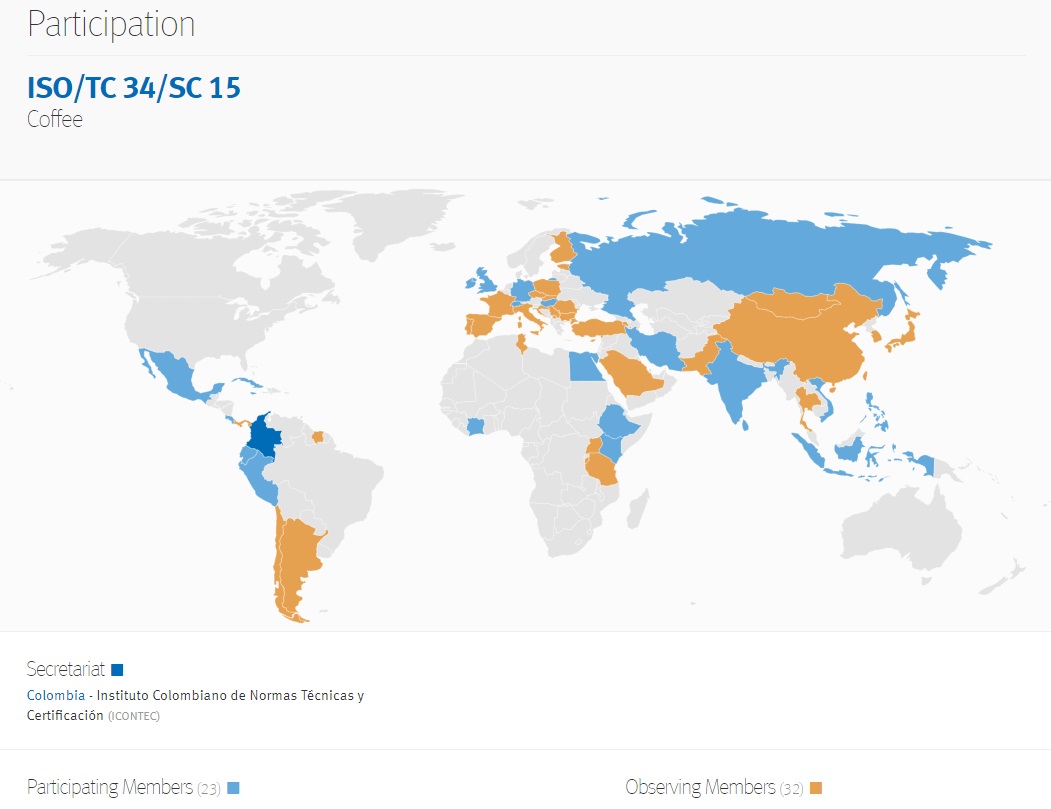
Today we revisit a product familiar to daily life at home and in business: coffee.   The ISO administers leading practice discovery and promulgation in the global coffee value chain through parent Technical Committee 34 (TC34) with the Association Française de Normalisation as the global Secretariat with the Associação Brasileira de Normas Técnicas as the twinned Secretariat*.  Subcommittee 15 oversees standardization in the field of coffee and coffee products, covering the coffee chain from green coffee to consumption, in particular. Standardization includes terminology, sampling, test methods and analysis, product specifications and requirements for packaging, storage and transportation

From the ISO/TC 34 prospectus:

Business Plan ISO TC34 Food Products

Sample from ISO Online Browing Platform: (Expect strong access firewalls)

Coffee and coffee products — Vocabulary

Coffee — Sensory analysis — Vocabulary

Roasted ground coffee — Determination of moisture content

The Secretariats for this subcommittee is currently held by Colombia (ICONTEC) but, with ANSI announcing in 2019 that it is relinquishing its role as the US Technical Advisory Group Administrator in 2019, there has been no US stakeholder participating.  In 2019 ANSI posted an invitation for another US-based stakeholder to assume the voice of the United States:

ANSI Standards Action Page 34

ANSI US TAGs to the International Organization for Standardization

Apart from the passion that young people have for fair trade in any market, we see this as an opportunity for faculty and students to gain insight into the geo-politics of food supply generally and the subtleties of coffee markets.   Business schools, agricultural colleges, international studies program developers who may be, and should be, interested in a leadership opportunity on behalf of the United States should communicate directly with ANSI’s ISO Team ((isot@ansi.org).

We devotes an hour every month to review public commenting opportunities on all international standards.  The work products of TC 34 appears on the standing agenda of both our Global and Food teleconferences.   See our CALENDAR for the next online meeting.


Issue: [19-46]

Category: Academic, International

Colleagues: Mike Anthony, Christine Fischer

* ISO Guidance on Twinning


LEARN MORE:

“The Golden Cup” Coffee Standards

“Gold Cup History & Future”


S. 1949 School Food Modernization Act of 2019

434 lawmakers, including 89 new freshman Members, were sworn in to the 116th Congress on January 3, 2019. Photo by Phi Nguyen.

A bill to amend the Richard B. Russell National School Lunch Act to require the Secretary of Agriculture to make loan guarantees and grants to finance certain improvements to school lunch facilities, to train school food service personnel, and for other purposes.


Standing Agenda / Food

This content is accessible to paid subscribers. To view it please enter your password below or send mike@standardsmichigan.com a request for subscription details.

ASTM F26 | Food Service Equipment



The development of standard definitions, specifications, test methods, and performance requirements for food service equipment. This Committee will coordinate its activities with other ASTM Committees. Where appropriate, standards developed by other nationally recognized organizations will be adopted and referenced.
“Food service equipment is apparatus intended for use in commercial and institutional establishments for handling, storage, preparation, cooking, holding, display, dispensing, and/or the serving of food which, at the time of serving, is ready for direct consumption on or off the premises. Also included are cleaning, sanitation and ancillary items associated with food preparation and service.”


Lorem ipsum


https://www.astm.org/COMMITTEE/F26.htm


Meets in October

Layout mode
Predefined Skins
Custom Colors
Choose your skin color
Patterns Background
Images Background
Standards Michigan
error: Content is protected !!
Skip to content